Showing posts with label German aircraft art. Show all posts

Fieseler Fi-156 Storch Art


Fi-156 Storch


The Fieseler Fi 156 Storch was a German liaison aircraft developed in the mid-1930s and became famous for its remarkable short takeoff and landing capabilities. First flown in 1936, the Storch was used during World War II for reconnaissance, liaison, and medical evacuation missions. Its large wings, fixed leading-edge slats, and long landing gear allowed it to fly at very low speeds. Around 2,900 aircraft were produced, and its distinctive appearance continues to attract aviation enthusiasts today. With its elegant lines and characteristic design, the Storch is also a popular subject in aviation art.

Junker Ju-87 Stuka Art

Ju-87 Stuka (Early Model)


The Junkers Ju 87 Stuka became one of the most recognizable dive bomber aircraft of World War II, often featured in dramatic aviation art paintings and illustrations.

Many aviation art artists depict the Stuka diving steeply toward its target, capturing the aircraft's role as a dedicated dive bomber with striking realism.

The distinctive gull wings and siren-equipped design of the Stuka make it a popular subject in historical aviation art, highlighting its effectiveness as a dive bomber.

In classic aviation art scenes, the Stuka is frequently shown descending through clouds as a dive bomber, emphasizing both its tactical purpose and iconic appearance.

FW-189 UHU Art

Fw-189 UHU


Very unusually shaped, the FW-189 UHU (The Owl) mostly served the reconnaisance missions over the eastern front.

Fw-189 was called Rama (The Frame) by the Soviet forces because of the aircraft's nose that was built as all-frame to increase visibility.

Ta-152 Art


Ta-152


The famous german engineer Kurt Tank had another marvel, named Ta-152.

It was a high-altitude, high-speed fighter which originally derived from FW-190.

It had a characteristic long-nose that distinguishes it with ordinary Focke-Wulfs.

Boasting a massive speed at high altitudes, Ta-152 came too late to affect the outcome of the war.

Do. 335 Pfeil Art


Do.335

The fastest piston engine aircraft of the World War Two, Dornier Do.335 came out too late to have any impact on the fianl outcome of the war.

Boasting an additional propeller at the aft section of the aircraft, Do. 335 had two engines powering two separate propellers. 

Depicted in this marvelous art is a two seater trainer version.

Enjoy.


Ho 229 Horten Art


Ho 229 Horten

Another example of the German engineering in WW2, Ho 229 had a unique design that was way ahead of its time. Though it never saw combat, its philosphy reamined to be revered by the next generations.

Enjoy this magnificent piece of art where a Hortan shoots down an allied long range bomber.

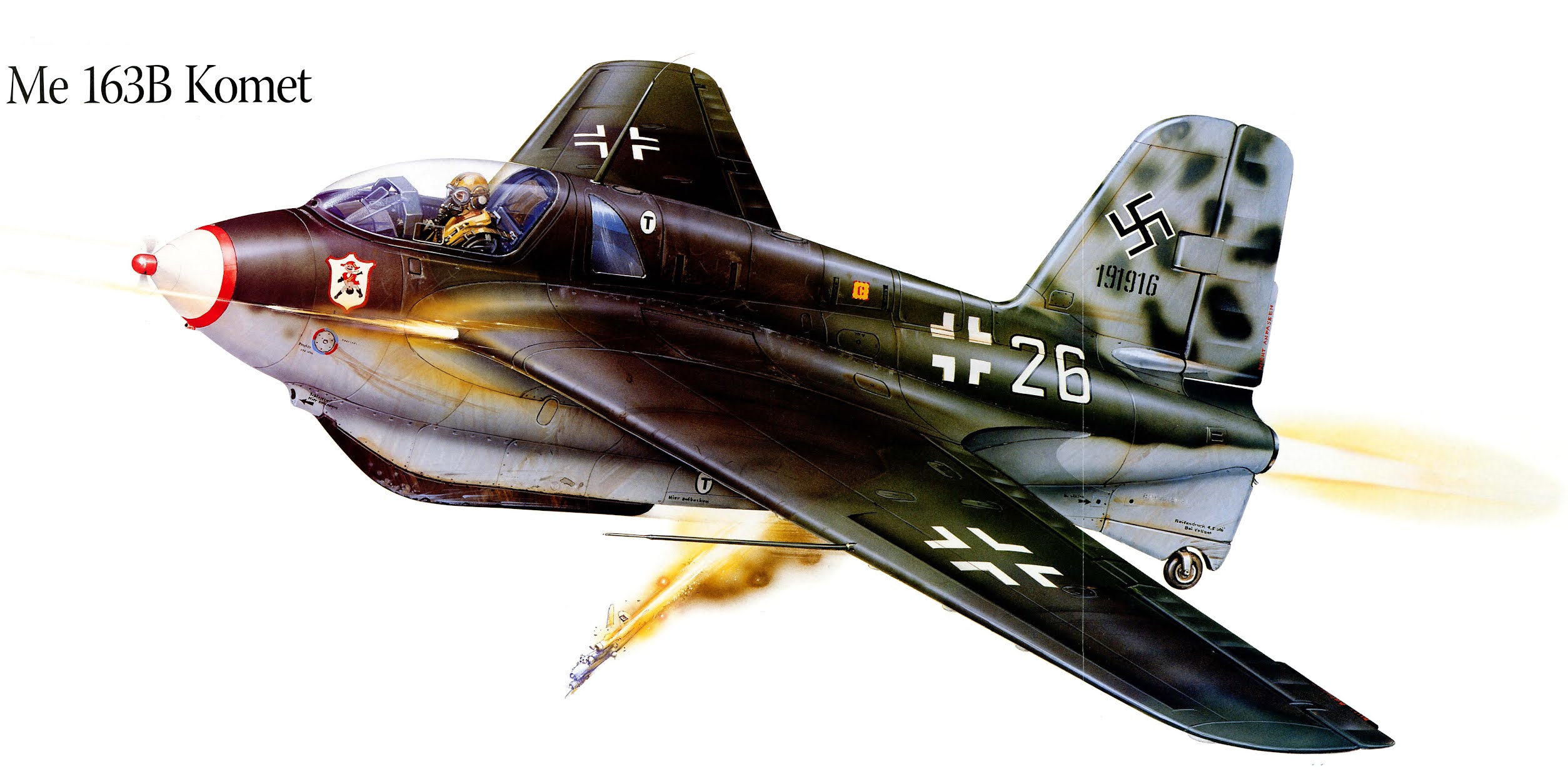
Me-163 Komet Art

Me-163 Komet


Me-163 Komet, way ahead of its time, presented  how the aviation technology had developed during the WW2. It was rocket-powered, it didn't carry any undercarriage and it lacked proper range to fight.

Yet it was the fastest aircraft seen on the skies over Europe. Due to it having propelled by an unconvetional engine, it lost its power after depleting the special form of chemicals that the rocket engine uses to burn. After that, Me-163 became a simple glider, making it vulnarable to enemy fire until it glided down to the runway safely.

Me-262 Schwalbe Art


The first operational fighter jet in the history, Me-262 Schwalbe fought in the later phases of the WW2. Her speed was no match for any allied fighter in the sky. However, she lacked the maneuverability of the conventional propeller-driven aircraft. Still, they came out victorious more than half of the encounters.
She had a capacity to take a huge punch on everything she attacks thanks to her generously laid heavy weapons. You could even load an anti-tank gun right below her wings.

Ju-87 Stuka Art


The famous Blitzkrieg was led by the bombs dropped by the Stukas. In spite of being heavy and slow, Stukas devastated the enemy lines with their pinpoint accuracy. Here the Stuka was camouflaged to resemble the sands of the desert. Obliviously she is fighting in North Africa, probably helping Rommel's ground forces.