
 |
| Mig-23 Flogger |
Another Soviet classic aircraft, Mig-23 Flogger stuns the viewers with its agile look. Boasting a swept wing technology, this jet was very fast in its era.
Enjoy the Mig-23 Flogger Art...
.jpeg)
Lightning II

Mig-17
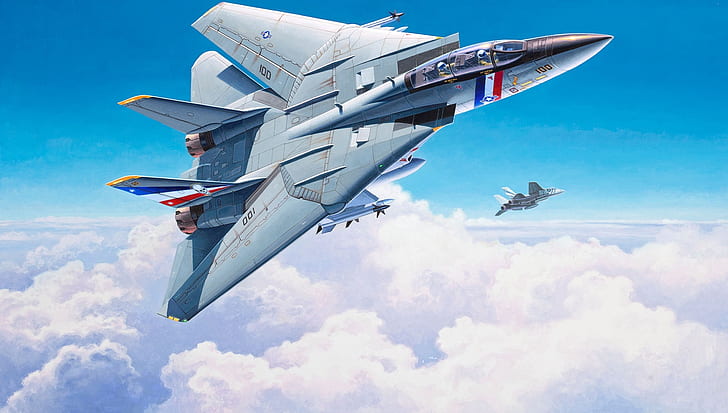
Tomcat
|
| Mig-23 Flogger |


SR-71 Blackbird is made by World-Famous Skunkworks, a group of very talented engineers from Lockheed.
It could out-fly just about anything with wings, boasting a top speed of 3,2 mach.
 |
| F-14 Tomcat |
One of the most legendary fighter jets of all time, F-14 Tomcat ruled the skies until late 1990s. With its sleek design, the Tomcat had even appeared on movies. Top Gun movie featured the Tomcat, making the aircraft a legend among aviation lovers.
Enjoy....

 |
| Mitsubishi Zero Art |
Japanese Zeros, or Zekes as the American call it, showed great resilience during the Pacific War. They had good manouevering abilities as well as a good amount of speed.
A6M1 Zero aircraft was also used to attack seaborne target with a capability to carry torpedoes.
Enjoy the Japanese Zero Fighter Art.
 |
| Chengdu J-20 |
Chengdu J-20 Mighty Dragon is the China's answer to American F-22 Raptor. Acquiring the stealth technology can be the biggest step the Chine took in the field of aviation.
They came up with a stealth jet in a short amount of time, surprising all the pundits around the world.
Enjoy the J-20 Mighty Dragon art....
 |
| MQ-9 Reaper Preadator |
UAVs have started to shape the future of the air warfare. Loitering over the area for hours, it can strike targets with precision.
Enjoy the U.S. made MQ-9 Predator art...


Air battles over North Africa is rather an untouched part of the WW2. Yet the battles there took place in its own form, where the desert conditions played a huge role.
While two armies fought on the desert, an equally violent war continued to be raged in the air.
With a desert laying as vast as the eye can see, the air battles under the burning sun took its toll on the pilots.
It sure was not an easy task.
Enjoy the art of aircraft over the desert....
 |
| Fw-189 UHU |
Very unusually shaped, the FW-189 UHU (The Owl) mostly served the reconnaisance missions over the eastern front.
Fw-189 was called Rama (The Frame) by the Soviet forces because of the aircraft's nose that was built as all-frame to increase visibility.
 |
| A400M |
A giant cargo plane made by Europe, A400 M fills the need for an efficient cargo hauler for military use.
Possessing 4 turbopros, the aircraft can make long distance travel with less fuel.
Enjoy the spectacular art of A400m....


Anti-aircraft weapons has been advanced since the old days. Modern systems have now capability to track the target and fire at an incredible pace.

 |
| Ta-152 |
The famous german engineer Kurt Tank had another marvel, named Ta-152.
It was a high-altitude, high-speed fighter which originally derived from FW-190.
It had a characteristic long-nose that distinguishes it with ordinary Focke-Wulfs.
Boasting a massive speed at high altitudes, Ta-152 came too late to affect the outcome of the war.
 |
| Bristol Beaufighter |
Enjoy this beautiful Beaufighter illustration...
 |
| Concorde |
 |
| B-26 Marauder |
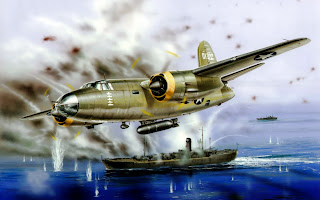
Produced by Martin Aviation Company, B-26 was a medium-range bomber with good amount of speed.
The speed was mostly attributed to its shorter wing span, which in turn caused the bomber to be too hot during take-off and landing. It needed to land too fast, leading to accidents.
The Marauder did well in Europe although she suffered big losses in some bombing campaigns.
The production ceased after the war.
 |
| Do.335 |
The fastest piston engine aircraft of the World War Two, Dornier Do.335 came out too late to have any impact on the fianl outcome of the war.
Boasting an additional propeller at the aft section of the aircraft, Do. 335 had two engines powering two separate propellers.
Depicted in this marvelous art is a two seater trainer version.
Enjoy.
 |
| Po-2 |
Originally produced for training mission, this biplane was also called U-2. It earned its fame when it was used by an all-female group of pilots as a night bomber. This pilots were called "Night Witches" by the Germans since they only attack at night under in an unexpected fashion.
Po-2 or U-2 proved to fit these kind of missions very well. Its low speed made the aircraft hard to shoot as faster German fighter planes struggled to slow down to get an aim at them.
Enjoy this beautiful piece of Po-2...
 |
| Ho 229 Horten |
Another example of the German engineering in WW2, Ho 229 had a unique design that was way ahead of its time. Though it never saw combat, its philosphy reamined to be revered by the next generations.
Enjoy this magnificent piece of art where a Hortan shoots down an allied long range bomber.

 |
| Mig-23 Flogger |
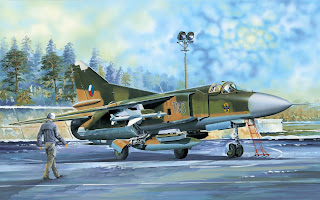
A workforce around the globe, Mig-23 Flogger has been the pinnacle of low-cost fighters with a considerably higher firepower.
I was cheap, it was easy to maintain and when it comes to delivering its pay load, it did well.
Beautiful fighter..

 |
| F-22 Raptor |
Here is the two amateur drawings of the Raptor. They are still good.
 |
| Me-163 Komet |
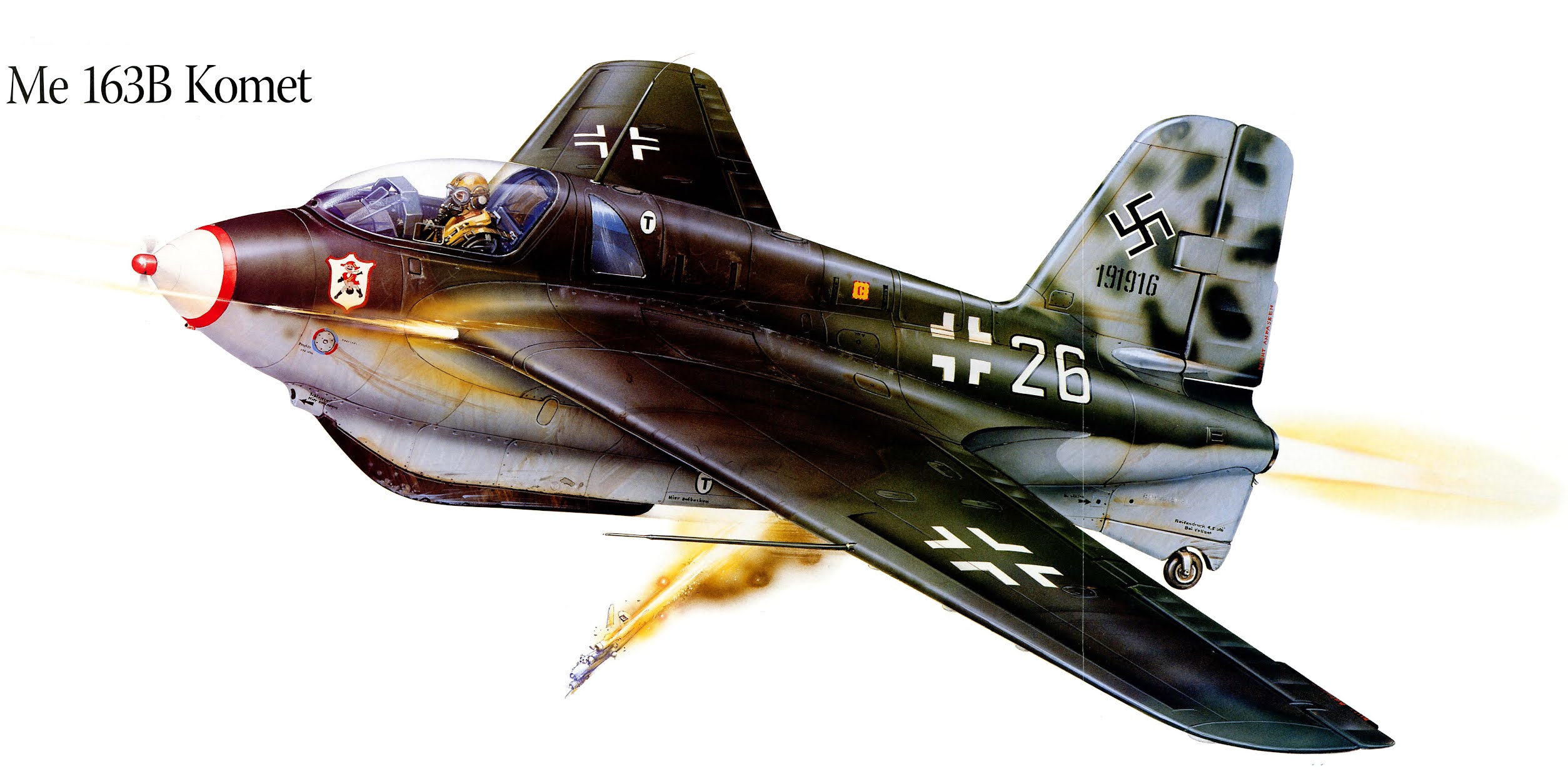
Me-163 Komet, way ahead of its time, presented how the aviation technology had developed during the WW2. It was rocket-powered, it didn't carry any undercarriage and it lacked proper range to fight.
Yet it was the fastest aircraft seen on the skies over Europe. Due to it having propelled by an unconvetional engine, it lost its power after depleting the special form of chemicals that the rocket engine uses to burn. After that, Me-163 became a simple glider, making it vulnarable to enemy fire until it glided down to the runway safely.


